

JOHESU Halts Industrial Action After 84 Days
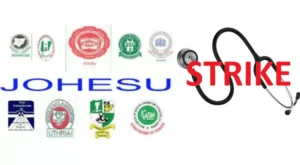 The Joint Health Sector Unions (JOHESU) has suspended its nationwide strike after 84 days of industrial action.
The decision followed an expanded National Executive Council emergency meeting held in Abuja on Friday, February 5.
The meeting, it was gathered, was convened to review the outcomes of the Federal Government–JOHESU conciliation meeting held on Thursday at the Federal Ministry of Labour and Employment headquarters.
According to a communiqué issued at the end of the meeting, the union said the strike had been suspended to allow for the implementation of the FG-JOHESU Terms of Settlement.
JOHESU stated that the decision was taken after deliberations on the resolutions reached during the conciliation engagement with the Federal Government.
gkingmusik reports that JOHESU had barely a month ago insisted that its indefinite national strike will continue, despite the Federal Government’s directive to enforce the ‘no work, no pay’ policy against its members.
The union stated this in a memo signed by its National Secretary, Martin Egbanubi, and addressed to presidents, general secretaries and state chairmen of its affiliate unions in Abuja.
According to the memo, the decision followed resolutions reached at an emergency virtual meeting of the union’s national leadership held on January 12, during which developments surrounding the industrial action were reviewed.
The leadership also examined reports submitted by affiliate unions and congresses across the country to assess the level of compliance with the strike nationwide.
It could be recalled that the Federal Government had earlier directed the implementation of the ‘no work, no pay’ policy, including the stoppage of its members’ salaries through the Office of the Accountant-General of the Federation.
JOHESU, however, has faulted the development and further reacted to a memo from the Federal Ministry of Health and Social Welfare, which instructed chief medical directors and managing directors of federal health institutions to enforce the policy.
The union described the ‘no work, no pay’ policy as a common pressure tool often deployed when government delays the resolution of labour disputes.
JOHESU insisted that the ongoing strike was justified, noting that it arose from its long-standing demand for the implementation of the adjusted Consolidated Health Salary Structure (CONHESS), alongside other unresolved welfare-related issues affecting its members.
The union maintained that it had complied fully with all procedures stipulated under the Trade Disputes Act before embarking on the strike.
It added that the industrial action qualified as a lawful dispute of right, and not a violation of existing industrial relations laws.








Leave a Reply